|
Entry Into the Recording Business by Michael Coyle
 |
| Like most 17 year-olds, I thought I was one-cool-dude. Featured are the two cassette machines and DJ mixer that comprised the first iteration of the basement studio |
In 1977, Disco was King, SkyLab was falling from the heavens, and I was working at Lafayette Radio which had just filed for bankruptcy. At seventeen years old, I didn't really care. There were dozens of other jobs available in the mall.
Lafayette was a nationwide chain of stereo stores similar to Radio Shack where after school and on weekends I would sell eight-track car players, turntables and disco mixers. Then one day our manager called us into his office and confiscated our store keys. He explained a liquidation company would assume control of the store and in a few weeks we would all be unemployed. As a consolation offer to employees who worked through the bankruptcy, he said we could place items in which we were interested in a storeroom until the last week of the liquidation sale when everything would be marked down 90%. We could then buy our stashed contraband at ten cents on the dollar. At first, I intended to pickup only a new home stereo.
My final Lafayette payroll check was for $300. Not only was it enough to buy a nice stereo system (which I still have to this day), but it also paid for a couple of cassette decks, a DJ disco mixer, and a few cheap microphones.
The purchase of the DJ equipment wasn't because I felt I could spin vinyl, but because all my friends were musicians. We put together a little recording studio in my basement and by using the two cassette machines, we dubbed from one machine to the other, adding a new instrument each time, until we had built up a song. While it was a lot of fun, the sound quality was horrible! The solution was to once again pool our money and purchased one of the first Tascam PortaStudio multitrack cassette recorders.
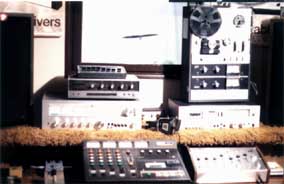 |
| After a few years, the basement studio had evolved. Bottom center is the 4 track cassette machine and in the upper right is a reel-to-reel for "Mastering"! |
Fortunately, my parents were very understanding. I believe they were relieved that my friends and I were spending our weekends in the basement recording songs rather than cruising neighborhood haunts. Some evenings there would be as many as eight of us in the basement hanging out and recording songs that were created out of thin air.
In this basement, there were two unused bedrooms. We had now commandeered these and placed a 2' by 3' window between them, creating what would become known for the next several years as the control room and studio.
As we moved on to college, the studio was still a frequent gathering place. Most of us continued to live at home and I attended the University of Illinois, Chicago as an electrical engineering student. This college had a 10 watt radio license and a popular student-run station.
One afternoon I visited the studios and asked the station manager if there were any openings. He threw his arms into the air exclaiming, "There is a long list of students who wish to be DJs. Add your name if you're really interested."
You could have knocked him over with a feather after I explained I didn't want to be a DJ; I was interested in audio engineering. He immediately gave me a tour of the facility and within days I was behind a console, engineering interviews of popular midwestern bands, and cutting together station promos that would air throughout the campus.
While my college grades were never stellar, I did have a great time learning at the station. Ater classes I would be at there working and on weekends I was still in my basement recording music.
In 1980, my third year of college, there were budget cuts and a decision was made to shutdown the radio station and sell the 10 watt radio license to Columbia College, a smaller four year accredited school in downtown Chicago.
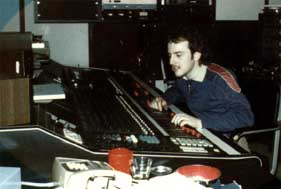 |
| Here in the college studio, I pretend to know what I'm doing. Do you dig the mustache? |
Being young and fearless, I transfered from the University of Illinois to Columbia College, dropping my plans for a BS degree to pursue a BA in Media Management - in other words, the recording industry.
I understood that graduating with a Bachelor of Science degree in Electrical Engineering would assure me of a high paying job after graduating, but I also knew I was happiest when I was behind a recording console.
With the change of schools came a change in my classroom attitude. Instead of doing the bare minimum as I had previously done, I was now often the last one out of the classroom, badgering the instructors for more information.
The best part of Columbia, and the reason I continue to recommend it, is that the instructors are all industry professionals. In my senior year, one of these instructors sponsored me for an internship at small recording studio that had been recently purchased by a friend of his.
When I arrived at the facility, I was shocked at the state of disrepair. Fifty year old vintage Neumann tube microphones were tossed onto shelves awaiting work on their power supplies. Boxes of busted cable and equipment filled every corner. The two room facility was built in 1968 and it looked as if no one had cared for it since the day it opened.
 |
| In an attempt to impress girls, I always carried my recording gear in the trunk. You never knew when an opportunity would arise to record a thunderstorm. (In additon to the bad mustache, I have added a crappy leather cowboy hat to my cool-dude look.) |
After working my regular day job until 5 pm, I would drive to the studio, working until midnight repairing equipment and cleaning the grime around the place. I was very fortunate that I had acquired the skill of soldering. It allowed me to immediately make an impart at the studio as box after box of old cables and headphones were once again returned to service.
When the semester was nearing its end, the owner offered me a full time job at the studio. I accepted even though it meant a five thousand dollar cut in pay!
It's a good thing I had the energy of a man in his early twenties because over the next two years I worked a minimum of eighty hours a week. During normal business hours, I would assist the senior engineer on commercial music sessions, and during the evenings I engineered low budget rock-n-roll projects.
The studio was located on the 11th floor of an old building with a very slow elevator. Some mornings I was so tired I would fall asleep standing against the elevator door on the ride up to the studio, being jarred awake as it opened to deposit me in the lobby.
Eventually I learned my trade and slowly made the transition to daytime senior engineer. At this point in 1983, MIDI was just making its arrival in keyboards. I clearly remember the day a musician arrived for a session with two Yamaha DX-7 synthesizers and after linking them together with a single cable, slaved one keyboard to the master allowing him to play both simultaneously.
It seemed like a small thing at the time, but before long, MIDI drum machines and sampling keyboards were added. At each step in its evolution, MIDI displaced live studio musicians. Soon, I was no longer recording drummers, bass players or guitarists. Names like Roland, Emu and SampleCell filled my vocabulary.
Instead of using the facilities of an expensive downtown studio, music producers could now put together a decent sounding track at home using MIDI keyboards. My work started to plummet just as my wife and I bought a house and were expecting a child.
 |
| To sharpen my skills, I would take my gear anywhere to record a band. This photo, in the basement of the local library recording a geriatric swing band, sadly shows the start of the receeding hairline. |
The company for which I worked was small, consisting of only one studio, but there were other facilities in town with multiple rooms. Some of these were dedicated to an area of the recording business where I had no previous experience: audio postproduction.
As a music engineer, when the music mix was finished it was sent to one of these larger facilities where addition sound effects and announcer tracks were added to complete the project before being broadcast. It seemed to me that no matter where the music track was recorded, the commercial would still be finished in a post production studio. Hopefully, that would mean a more steady flow of work.
It was 1983 when I made the decision to gradually phase out music engineering and shift my client base to post production. The transition took over five years to complete and meant a move to the largest recording facility in the city: The Chicago Recording Company.
As a generation that has grown up watching MTV, everyone is fairly familiar with the job of a music engineer, but the duties of a Post Production Engineer are substantially different and I have yet to see it accurately presented in the media.
 |
| By the age of thirty I was finally out of the basement. This post production room was one of the best in the city. |
The post engineer assembles the music, location dialog from the shoot, custom sound effects, and additional announcer voiceover, and completes the final mix of a commercial before it is broadcast. Unlike the music engineer, a post editor has fairly stable business hours from 9 to 5.
Generally a music engineer makes less money in the evening when studio rates drop, while post production the engineer gets overtime. A very successful music engineer may have two or three commercial music producers as his clients, but in post production a client list may contain over one hundred copywriters and producers.
While recording a 30 piece orchestra and rhythm section is a great rush for a music engineer, sadly sessions like these are few and far between in a cost conscious industry build around computer controlled samplers and synthesizers. As a post production engineer, it is not uncommon for me to see several commercials on which I've worked each evening on TV, and that brings its own feeling of satisfaction.
It's been 20 years since my internship and this business has changed substantially. Back in 1981, college internships in the recording industry were a new trend. Today many of the people wandering the halls of a facility are unpaid interns who get class credit in return for time spent learning at a studio. Unfortunately, many applicants looking for an entry level job do not feel passion for the craft of recording audio, but instead are looking for a way to further their music performance careers. This attitude is as transparent as glass to the studio manager, but since interns are free labor, many individuals with questionable intentions are given positions simply because their labor is free.
This leads to disenchantment on the part of the intern who is often delegated to fetching lunches for hungry clients. My advice to to aspiring musicians is to not waste your time seeking an internship at an audio studio believing it will provide access to music producers who can further your career. I haven't seen it happen once in twenty years and that's unlikely to change.
|
|
| My newest studio, which opened in October of 2001, is a real gem. Gone are the analog tape machines. Everyhting is computerized, synthesized, and digitized. |
Chicago has a large advertising and commercial music industry, and yet there are only a dozen successful post production engineers in the city. I often joke it's easier to get a job as a brain surgeon. So if you are interested in pursuing a career as a music or post production engineer the selection of your college is critical. Look for a school that has access to recording equipment and possibly strong film and television departments. Instructors who work within the industry are also a plus because they can help you make that critical first connection with an employer.
It's frustrating to graduate with a college degree yet struggle to gain an entry level position that pays slightly better than minimum wage, so get started early while you're young and expenses are lower.
It's a very difficult career in which to be successful. You have to want it badly and be willing to work long hours at a low salary for many years, but if you have that rare combination of great people-skills and a strong technical background, there are very few jobs you can enjoy more than that of a recording engineer.
|


